
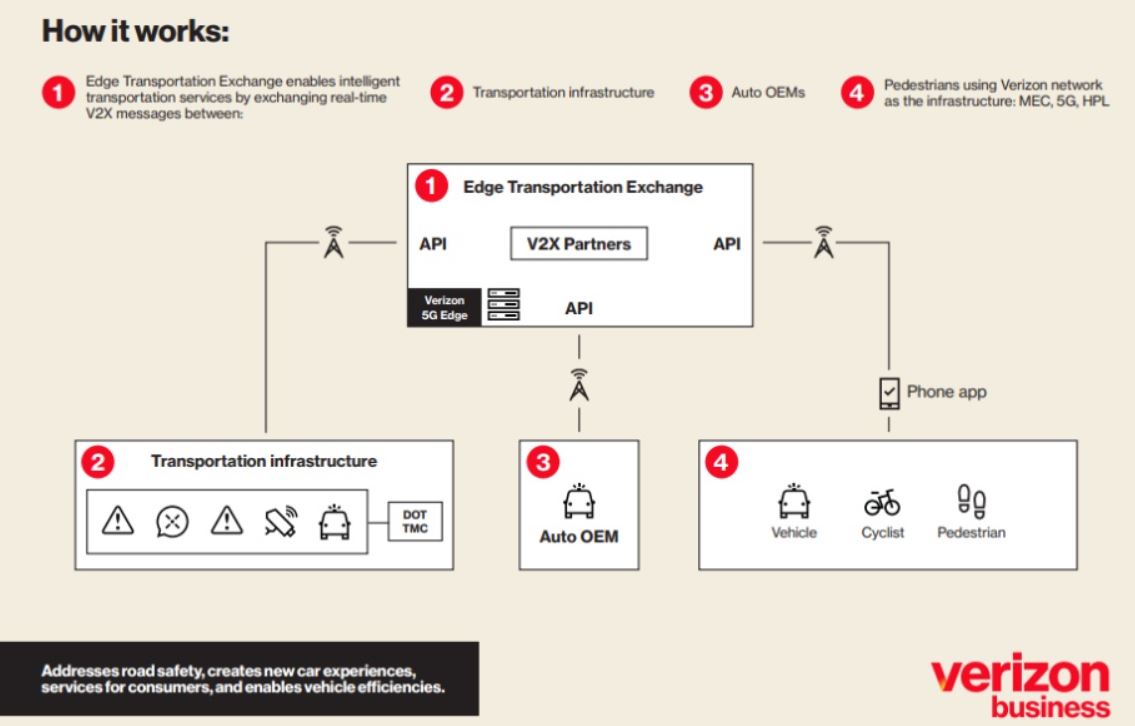

Both Verizon Business VZ 0.00%↑ and Qualcomm QCOM 0.00%↑ made recent announcements to ramp up their growing forays into vehicle-to-everything (V2X) markets. Verizon, which commercially launched Edge Transportation Exchange, a mobile-network V2X communication platform built on its 5G and LTE infrastructure alongside low-latency mobile edge computing and geolocation technology.
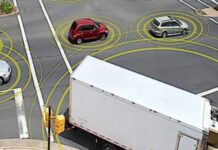
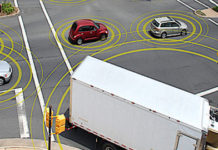
The platform enables near real-time alerts and data sharing among vehicles, pedestrians, and traffic infrastructure—supporting applications like vulnerable road-user detection, weather condition warnings and intersection signal timing notifications.

Early adopters include Volkswagen Group of America, the Arizona Commerce Authority, Delaware Department of Transportation, and Rutgers University CAIT, with deployments already underway to enhance urban mobility and road safety, the company said. Verizon said that its virtual architecture minimizes reliance on costly roadside units—and is tailored municipalities, automakers and tech developers to innovate and deploy connected-vehicle solutions.
The significance of this announcement lies in its shift from limited demonstration projects to full commercial availability, offering partners an operational platform to roll out V2X services at scale. As the industry moves toward software-defined mobility, Verizon’s platform aims to accelerate intelligent transportation deployment and improve real-world traffic efficiency and safety outcomes.
Qualcomm, with its estimated $350 million acquisition of Autotalks, is integrating production-ready DSRC and C‑V2X chips to accelerate the deployment of cooperative vehicle technologies, according to published reports.
The purchase—which first faced regulatory delays—gives automakers and infrastructure firms immediate access to production-ready, automotive-grade V2X solutions designed to improve road safety and traffic management. The deal positions Qualcomm to embed V2X capabilities in future commercial vehicles, allowing systems such as automatic braking and intersection alerts to become standard safety features.